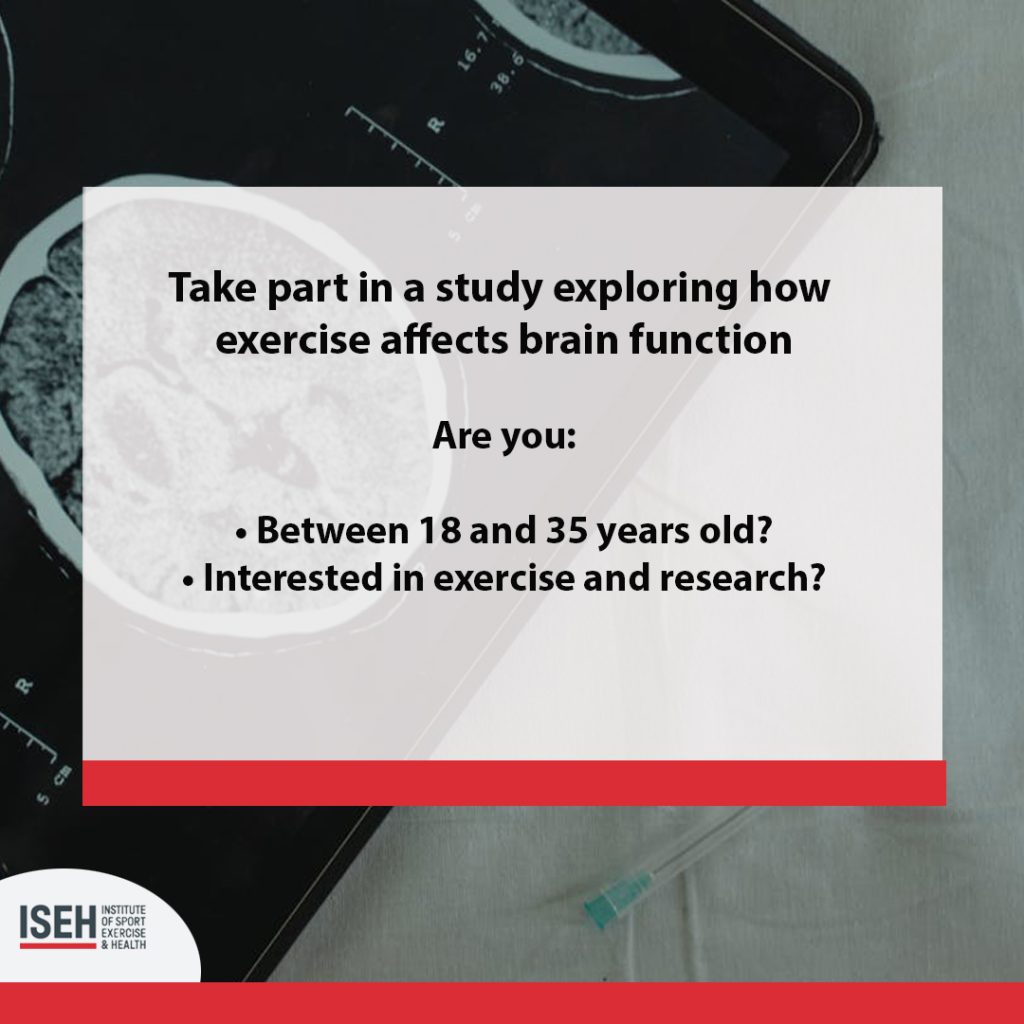
Participants Wanted! A small team of researchers at ISEH are recruiting volunteers to take part in a study exploring how exercise affects brain function.
Are you:
• Between 18 and 35 years old?
• Interested in exercise and research?
If so, the research team leading this would be very happy to hear from you. Full information about the study.
Study location: Institute of Sport, Exercise and Health (ISEH, 170 Tottenham Court Road, W1T 7HA).
The project’s purpose: Single bouts of exercise have been shown to support executive functioning – that is, the higher-order cognitive processes essential for everyday life, for up to an hour after exercise. However, the mechanisms driving this benefit remain unclear.
This project aims to investigate how different exercise modalities – including passive exercise, cycling, leg raises, and muscle stimulation, influence executive function in healthy adults. The data collected will contribute to ongoing research conducted by staff and students at UCL. This research is not intended for diagnostic purposes.
Specifically, the study explores how passive exercise – being moved by an external source rather than initiating movement yourself, may enhance cognitive function during and after activity. Passive exercise has proven effective as a rehabilitation technique, yet its role in supporting brain health remains poorly understood. To address this, we will compare its effects with three additional exercise sessions on separate days: aerobic cycling, resistance exercise, and electrical muscle stimulation.
To understand the relationship between these exercises and cognition, the team will measure:
- Brain activity using a light-based scanner placed on the head
- Blood glucose and lactate levels with 4 small finger-prick samples per session
- Muscle activity using sensors that track muscle signals
- Heart rate and blood pressure with a standard finger-pulse monitor
- Breathing and oxygen use with a machine that analyses air flow during exercise
- Cognition using a tablet-based pointing task
These outcomes will be useful to provide a comprehensive mechanistic understanding of how the exercises will differ and how this may translate to differences in cognitive outcomes. All sessions will last about 1.5 hours from set-up to completion.
Please take the time to read the following information carefully and discuss it with others if you wish. Ask us if there is anything that is not clear or if you would like more information. Take time to decide whether or not you wish to take part.
For any questions or to get involved, contact:
Dr Benjamin Tari: b.tari@ucl.ac.uk